Your dog is stretched out on the couch and you need them off. You reach for their collar and they go stiff, roll over or slide just out of reach. Or a squirrel darts up a tree on your walk, and suddenly you are attached to a dog who has forgotten you exist.
A hand target can help with both. It is one of the simplest skills you can teach, and most dogs love it. This guide covers what a hand target is, how to teach it step by step, the everyday ways to use it and how to fix the most common problems.
What Is a Hand Target?
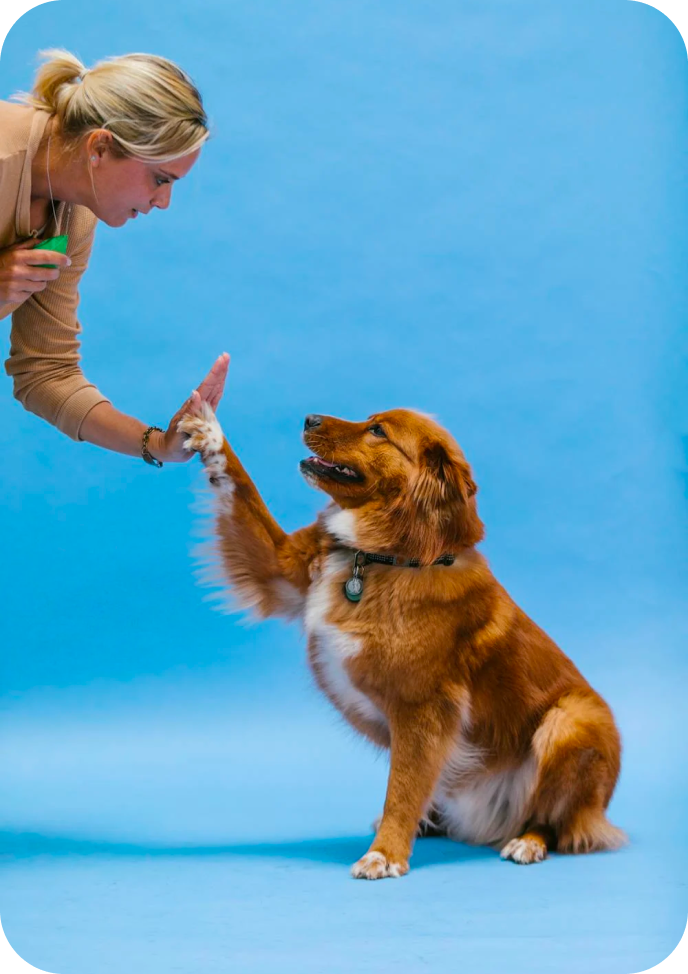
A hand target means your dog bumps their nose into the palm of your hand when you hold it out and say "Touch". Wherever your hand goes, your dog follows, without you needing to pull, push or grab.
Touch is also a great building block for coming when called, because your dog learns that running to your hand pays off. When you are ready for that next step, our guide on how to teach your dog to come when called picks up from here.
What You'll Need
- Small, soft treats your dog enjoys
- A quiet room with few distractions
- A marker: a word like "Yes" or a clicker that tells your dog the exact moment they got it right, always followed by a reward
It helps if your dog already turns when you say their name. Our post on the Name Game teaches that, and our post on teaching your dog to focus on you shows you how to introduce a marker.
How to Teach Your Dog a Hand Target, Step by Step
- Present a flat, still hand. With your dog close by, hold your open palm a few inches from their nose, a little to one side. Most dogs are curious enough to sniff it.
- Mark and reward the bump. The moment their nose touches your palm, say "Yes" and give a treat from your other hand. That keeps your target hand about the touch, not the food.
- Reset and repeat. Put your hand behind your back for a second, then offer it again. Do five to ten touches, then take a break.
- Help a dog who is unsure. If nothing happens after a few seconds, take your hand away and try again. At first you can also reward a glance or a step toward your hand, or rub a crumb of treat on your palm to make it more interesting.
- Add the word. When your dog bumps your hand almost every time, say "Touch" just as you present it. Over several sessions, the word becomes the signal.
- Add distance and direction. Hold your hand a little further away, so your dog takes a step to reach it. Then try it low, high, left and right. Never move your hand toward your dog's nose. You want your dog to come to you.
- Practice in new places. Try each room, then the yard, then the front step, starting close every time.
Everyday Uses for Touch
- Moving your dog off furniture. Instead of reaching for their collar, hold your hand low beside the couch and say "Touch". Your dog hops down, gets paid, and nobody ends up in a tug of war. The same trick guides them onto a scale, into the car or through a doorway.
- Redirecting attention on walks. When something exciting appears, offer your hand at your side and say "Touch" as you keep walking. It gives your dog something to do other than stare, bark or pull. Start well away from distractions.
- Polite greetings. Ask for a touch as a guest walks in. A dog bumping your hand has four paws on the floor and a job to do.
- A calm job for worried dogs. A simple, familiar task can help a nervous dog cope with a moment they find hard, like passing another dog at a distance or waiting at the vet. If your dog barks and lunges on walks, our guide to leash reactivity explains how skills like this fit into a wider plan.
Common Mistakes and How to Fix Them
Moving your hand to meet your dog. Your dog learns to wait for your hand to come to them. Keep it still and let them do the work.
Repeating the word. "Touch, touch, touch" teaches your dog that the first one does not count. Say it once. If nothing happens, take your hand away and make the next try easier.
Licking or mouthing. Mark the very first light contact, before a tongue or teeth arrive. Mouthy puppies often do better with shorter sessions and two fingers offered instead of a whole palm.
Asking for too much too soon. If your dog stops responding after you add distance or a distraction, go back to the last easy step, get a few wins, then build up in smaller steps.
Frequently Asked Questions
Is Touch the same as a recall?
No, but it is a very good place to start. Touch teaches your dog to move toward your hand. A recall asks them to come all the way to you from a distance, often with distractions around, and it is taught as its own skill.
Can my dog learn to touch other things?
Yes. Many dogs go on to target a sticky note, a lid or a mat, which can lead to tricks like closing a door and can help some dogs feel braver around new objects.
Can I use Touch to help my dog hold still?
Yes. Wait a moment longer before you mark, building up to a second or two, so your dog learns to keep their nose on your palm. It is useful for grooming, putting on a harness and vet checks.
How Dogwise Can Help
In every Dogwise program, your dog lives in their trainer's home and practices the skills that help them most in real life, every day. Puppy Foundations gives puppies of around 16 weeks to 6 months a strong start with the basics. If your dog is anxious, Anxiety Support is built for worried dogs, noise fears and separation problems, at a pace your dog can handle. Our programs finish with a handover in your own home and follow-up sessions, so the skills keep working with you.
Want help building skills like this? Book a free consultation and tell us about your dog. We will help you find the right next step.